
AI-assisted content notice: This documentation was created with support from artificial intelligence and has been reviewed by humans for accuracy.
CakePHP Back-End
Baking the Module
Before you begin, make sure you are in the /opt/openitc/frontend directory and have created a new Git branch for your development work.
cd /opt/openitc/frontend
git checkout -b example_module

openITCOCKPIT provides its own CLI tool, oitc, which can generate a "skeleton" for a new module. This process is called baking and is based on the CakePHP bake command.
To create a new module, run the following command:
oitc bake plugin ExampleModule
Note
Your module name must end with Module. Examples: ExampleModule, AutoreportsModule, MkModule, etc.
The system will ask you to confirm the plugin directory:
Plugin Directory: /opt/openitc/frontend/plugins/ExampleModule
Confirm by entering y.
Next, you will be asked whether you want to overwrite the following file:
/opt/openitc/frontend/composer.json
Do not overwrite this file. Enter n to skip this step.
Example output of the bake command:
root @ /opt/openitc/frontend - [ExampleModule] # oitc bake plugin ExampleModule
Plugin Name: ExampleModule
Plugin Directory: /opt/openitc/frontend/plugins/ExampleModule
-------------------------------------------------------------------------------
Look okay? (y/n/q)
[y] > y
Generating .gitignore file...

Creating file /opt/openitc/frontend/plugins/ExampleModule/.gitignore
Wrote `/opt/openitc/frontend/plugins/ExampleModule/.gitignore`
Generating README.md file...

Creating file /opt/openitc/frontend/plugins/ExampleModule/README.md
Wrote `/opt/openitc/frontend/plugins/ExampleModule/README.md`
Generating composer.json file...

Creating file /opt/openitc/frontend/plugins/ExampleModule/composer.json
Wrote `/opt/openitc/frontend/plugins/ExampleModule/composer.json`
Generating phpunit.xml.dist file...

Creating file /opt/openitc/frontend/plugins/ExampleModule/phpunit.xml.dist
Wrote `/opt/openitc/frontend/plugins/ExampleModule/phpunit.xml.dist`
Generating src/Controller/AppController.php file...

Creating file /opt/openitc/frontend/plugins/ExampleModule/src/Controller/AppController.php
Wrote `/opt/openitc/frontend/plugins/ExampleModule/src/Controller/AppController.php`
Generating src/Plugin.php file...

Creating file /opt/openitc/frontend/plugins/ExampleModule/src/Plugin.php
Wrote `/opt/openitc/frontend/plugins/ExampleModule/src/Plugin.php`
Generating tests/bootstrap.php file...

Creating file /opt/openitc/frontend/plugins/ExampleModule/tests/bootstrap.php
Wrote `/opt/openitc/frontend/plugins/ExampleModule/tests/bootstrap.php`
Generating webroot/.gitkeep file...

Creating file /opt/openitc/frontend/plugins/ExampleModule/webroot/.gitkeep
Wrote `/opt/openitc/frontend/plugins/ExampleModule/webroot/.gitkeep`
Modifying composer autoloader

File `/opt/openitc/frontend/composer.json` exists
Do you want to overwrite? (y/n/a/q)
[n] > n
Skip `/opt/openitc/frontend/composer.json`

Generating autoload files
Generated autoload files


/opt/openitc/frontend/src/Application.php modified
-------------------------------------------------------------------------------
Created: ExampleModule in /opt/openitc/frontend/plugins/ExampleModule


root @ /opt/openitc/frontend - [ExampleModule] #
Repairing File Permissions
Whenever you use the oitc command to generate files, it is recommended to assign the generated files to the web server user www-data.
openITCOCKPIT provides a built-in command for setting the correct file permissions.
oitc rights

Cleaning Up Application.php
Open /opt/openitc/frontend/src/Application.php and remove the following line:
$this->addPlugin('ExampleModule');
openITCOCKPIT automatically loads all modules, so no manual registration is required.
Changing the Routing
By default, CakePHP uses a hyphen (-) as the CamelCase separator in URLs. However, for historical reasons, openITCOCKPIT requires an underscore (_) instead.
Open /opt/openitc/frontend/plugins/ExampleModule/src/Plugin.php and locate the following code:
public function routes(RouteBuilder $routes): void
{
    $routes->plugin(
        'ExampleModule',
        ['path' => '/example-module'],
        function (RouteBuilder $builder) {
            // Add custom routes here

            $builder->fallbacks();
        }
    );
    parent::routes($routes);
}
Change the path value from example-module to example_module:
['path' => '/example_module'],
Baking the Controller
oitc bake controller Test -p ExampleModule
This creates a new controller where you can implement your API actions.
<?php
// Copyright (C) <2015-present>  <it-novum GmbH>
//
// This file is dual licensed
//
// 1.
//     This program is free software: you can redistribute it and/or modify
//     it under the terms of the GNU General Public License as published by
//     the Free Software Foundation, version 3 of the License.
//
//     This program is distributed in the hope that it will be useful,
//     but WITHOUT ANY WARRANTY; without even the implied warranty of
//     MERCHANTABILITY or FITNESS FOR A PARTICULAR PURPOSE.  See the
//     GNU General Public License for more details.
//
//     You should have received a copy of the GNU General Public License
//     along with this program.  If not, see <http://www.gnu.org/licenses/>.
//
// 2.
//     If you purchased an openITCOCKPIT Enterprise Edition you can use this file
//     under the terms of the openITCOCKPIT Enterprise Edition license agreement.
//     License agreement and license key will be shipped with the order
//     confirmation.

declare(strict_types=1);

namespace ExampleModule\Controller;

use ExampleModule\Model\Table\MypluginSettingsTable;

class TestController extends AppController {
    public function index() {
        // More code to come...
    }
}
Assigning Permissions to the "Administrator" Role
By default, access to all API actions is denied.
To automatically assign all permissions to the Administrator role, run:
openitcockpit-update --no-system-files
If your current user is not part of the Administrator role, navigate to:
Administration -> User Management -> Manage User Roles
and assign the required permissions manually.
AclDependencies
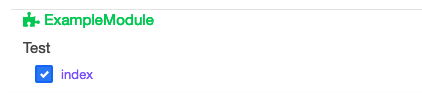
By default, every controller action creates its own user permission.
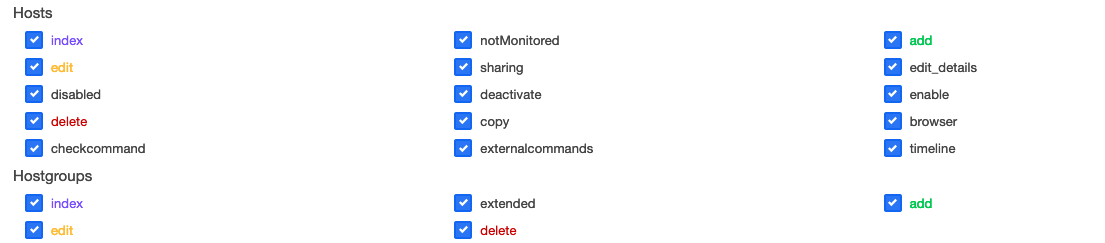
Some actions depend on other actions, and disabling a specific permission could affect the functionality of the entire application.
To prevent this, you can define ACL dependencies.
ACL dependencies are configured in:
/opt/openitc/frontend/plugins/ExampleModule/src/Lib/AclDependencies.php
<?php
namespace ExampleModule\Lib;

use App\Lib\PluginAclDependencies;

class AclDependencies extends PluginAclDependencies {

    public function __construct() {
        parent::__construct();

        // Add actions that should always be allowed.
        $this
            //      Controller name, Action mame
            ->allow('Test', 'foobar');

        ///////////////////////////////
        //    Add dependencies       //
        //////////////////////////////

        $this
            //           Controller name, Action name, depends on: Controller name, Action name
            ->dependency('Test', 'foo', 'Test', 'bar');
    }
}
Actions marked as always allowed or defined as dependencies can no longer be configured individually for user roles. These permissions are managed automatically by the system.
Whenever you modify AclDependencies, run:
openitcockpit-update --no-system-files
Menu Items
By default, the openITCOCKPIT menu is divided into four categories (MenuHeadline):
- Overview
- Monitoring
- Administration
- System Configuration
You can either add menu entries to these categories or create your own custom category.
All menu definitions for your module are located in:
/opt/openitc/frontend/plugins/ExampleModule/src/Lib/Menu.php
Adding a Menu Entry to an Existing Heading
PHP Code
<?php

namespace ExampleModule\Lib;


use itnovum\openITCOCKPIT\Core\Menu\MenuCategory;
use itnovum\openITCOCKPIT\Core\Menu\MenuHeadline;
use itnovum\openITCOCKPIT\Core\Menu\MenuInterface;
use itnovum\openITCOCKPIT\Core\Menu\MenuLink;

class Menu implements MenuInterface {

    /**
     * @return array
     */
    public function getHeadlines() {
        $Overview = new MenuHeadline(\itnovum\openITCOCKPIT\Core\Menu\Menu::MENU_OVERVIEW);
        $Overview
            //Create a new Sub-Category of the Overview Headline
            ->addCategory((new MenuCategory(
                'ExampleModule',
                __('Example Module'),
                1000,
                ['fas', 'burn']
            ))
                //Add new Link to Sub-Category
                ->addLink(new MenuLink(
                    __('Hello world'),
                    'TestIndex', // Name of the NG-State, historically needed but may be deprecated in the future
                    'Test', // Name of the PHP Controller
                    'index', // Name of the PHP action
                    'ExampleModule', //Name of the Module
                    ['fas', 'code'], //Menu Icon
                    [],
                    1,
                    true,
                    'example_module/index' //URL to the action
                ))
            );

        return [$Overview];
    }

}
Result
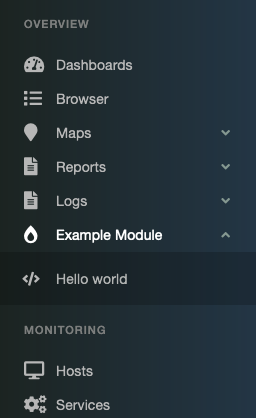
Run the following command to update the menu:
openitcockpit-update --no-system-files
Creating Menu Items Under a New Heading
If required, you can also create your own menu headings.
PHP Code
<?php

namespace ExampleModule\Lib;


use itnovum\openITCOCKPIT\Core\Menu\MenuCategory;
use itnovum\openITCOCKPIT\Core\Menu\MenuHeadline;
use itnovum\openITCOCKPIT\Core\Menu\MenuInterface;
use itnovum\openITCOCKPIT\Core\Menu\MenuLink;

class Menu implements MenuInterface {

    /**
     * @return array
     */
    public function getHeadlines() {
        $ExampleModuleHeadline = new MenuHeadline(
            'ExampleModuleHeadline',
            __('Example Module')
        );
        $ExampleModuleHeadline
            //Create a new Sub-Category of the Overview Headline
            ->addCategory((new MenuCategory(
                'ExampleModule',
                __('Example Module'),
                1000,
                'fas burn'
            ))
                //Add new Link to Sub-Category
                ->addLink(new MenuLink(
                    __('Hello world'),
                    'TestIndex', // Name of the NG-State, historically needed but may be deprecated in the future
                    'Test', //Name of the PHP Controller
                    'index', //Name of the PHP action
                    'ExampleModule', //Name of the Module
                    ['fas', 'code'], //Menu Icon
                    [],
                    1,
                    true,
                    'example_module/index' //URL to the action
                ))
            );

        return [$ExampleModuleHeadline];
    }
}
Result
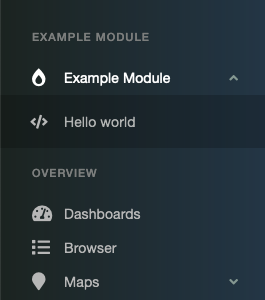
Run the following command to update the menu:
openitcockpit-update --no-system-files
Database Access
Creating a Migration
Migrations are used to modify your database schema. They allow you to create, alter, and remove tables or columns without writing SQL manually.
oitc migrations create -p ExampleModule Initial
This creates a new, empty migration file at:
/opt/openitc/frontend/plugins/ExampleModule/config/Migrations/<timestamp>_Initial.php
Example migration:
<?php
// Copyright (C) <2015-present>  <it-novum GmbH>
//
// This file is dual licensed
//
// 1.
//     This program is free software: you can redistribute it and/or modify
//     it under the terms of the GNU General Public License as published by
//     the Free Software Foundation, version 3 of the License.
//
//     This program is distributed in the hope that it will be useful,
//     but WITHOUT ANY WARRANTY; without even the implied warranty of
//     MERCHANTABILITY or FITNESS FOR A PARTICULAR PURPOSE.  See the
//     GNU General Public License for more details.
//
//     You should have received a copy of the GNU General Public License
//     along with this program.  If not, see <http://www.gnu.org/licenses/>.
//
// 2.
//     If you purchased an openITCOCKPIT Enterprise Edition you can use this file
//     under the terms of the openITCOCKPIT Enterprise Edition license agreement.
//     License agreement and license key will be shipped with the order
//     confirmation.

declare(strict_types=1);

use Migrations\AbstractMigration;

class Initial extends AbstractMigration {

    /**
     * Change Method.
     *
     * More information on this method is available here:
     * https://book.cakephp.org/phinx/0/en/migrations.html#the-change-method
     * @return void
     */
    public function change(): void {
        $table = $this->table('myplugin_settings');
        $table->addColumn('webhook_url', 'string', [
            'default' => '',
            'limit'   => 255,
            'null'    => false,
        ]);
        $table->addColumn('created', 'datetime', [
            'default' => null,
            'null'    => false,
        ]);
        $table->addColumn('modified', 'datetime', [
            'default' => null,
            'null'    => false,
        ]);
        $table->create();
    }
}
Running the Migration
Creating a migration is only the first step. To apply it, execute:
oitc migrations migrate -p ExampleModule
You can verify the new table using the MySQL CLI or phpMyAdmin.
An entry is also added to the phinxlog table to ensure the migration is not executed again.
Creating Models
With the database table in place, you can now generate the corresponding model classes.
CakePHP's ORM handles creating, reading, updating, and deleting records, so you don't need to write SQL manually.
Generate the Table and Entity objects:
oitc bake model -p ExampleModule MypluginSettings
This command creates both Entity and Table objects in:
-
plugins/ExampleModule/src/Model/Entity<?php // Copyright (C) <2015-present> <it-novum GmbH> // // This file is dual licensed // // 1. // This program is free software: you can redistribute it and/or modify // it under the terms of the GNU General Public License as published by // the Free Software Foundation, version 3 of the License. // // This program is distributed in the hope that it will be useful, // but WITHOUT ANY WARRANTY; without even the implied warranty of // MERCHANTABILITY or FITNESS FOR A PARTICULAR PURPOSE. See the // GNU General Public License for more details. // // You should have received a copy of the GNU General Public License // along with this program. If not, see <http://www.gnu.org/licenses/>. // // 2. // If you purchased an openITCOCKPIT Enterprise Edition you can use this file // under the terms of the openITCOCKPIT Enterprise Edition license agreement. // License agreement and license key will be shipped with the order // confirmation. declare(strict_types=1); namespace ExampleModule\Model\Entity; use Cake\ORM\Entity; /** * MypluginSetting Entity * * @property int $id * @property string $webhook_url * @property \Cake\I18n\FrozenTime $created * @property \Cake\I18n\FrozenTime $modified */ class MypluginSetting extends Entity { /** * Fields that can be mass assigned using newEntity() or patchEntity(). * * Note that when '*' is set to true, this allows all unspecified fields to * be mass assigned. For security purposes, it is advised to set '*' to false * (or remove it), and explicitly make individual fields accessible as needed. * * @var array<string, bool> */ protected $_accessible = [ 'webhook_url' => true, 'created' => true, 'modified' => true, ]; } -
plugins/ExampleModule/src/Model/Table<?php // Copyright (C) <2015-present> <it-novum GmbH> // // This file is dual licensed // // 1. // This program is free software: you can redistribute it and/or modify // it under the terms of the GNU General Public License as published by // the Free Software Foundation, version 3 of the License. // // This program is distributed in the hope that it will be useful, // but WITHOUT ANY WARRANTY; without even the implied warranty of // MERCHANTABILITY or FITNESS FOR A PARTICULAR PURPOSE. See the // GNU General Public License for more details. // // You should have received a copy of the GNU General Public License // along with this program. If not, see <http://www.gnu.org/licenses/>. // // 2. // If you purchased an openITCOCKPIT Enterprise Edition you can use this file // under the terms of the openITCOCKPIT Enterprise Edition license agreement. // License agreement and license key will be shipped with the order // confirmation. declare(strict_types=1); namespace ExampleModule\Model\Table; use Cake\ORM\Table; use Cake\Validation\Validator; /** * MypluginSettings Model * * @method \ExampleModule\Model\Entity\MypluginSetting newEmptyEntity() * @method \ExampleModule\Model\Entity\MypluginSetting newEntity(array $data, array $options = []) * @method \ExampleModule\Model\Entity\MypluginSetting[] newEntities(array $data, array $options = []) * @method \ExampleModule\Model\Entity\MypluginSetting get($primaryKey, $options = []) * @method \ExampleModule\Model\Entity\MypluginSetting findOrCreate($search, ?callable $callback = null, $options = []) * @method \ExampleModule\Model\Entity\MypluginSetting patchEntity(\Cake\Datasource\EntityInterface $entity, array $data, array $options = []) * @method \ExampleModule\Model\Entity\MypluginSetting[] patchEntities(iterable $entities, array $data, array $options = []) * @method \ExampleModule\Model\Entity\MypluginSetting|false save(\Cake\Datasource\EntityInterface $entity, $options = []) * @method \ExampleModule\Model\Entity\MypluginSetting saveOrFail(\Cake\Datasource\EntityInterface $entity, $options = []) * @method \ExampleModule\Model\Entity\MypluginSetting[]|\Cake\Datasource\ResultSetInterface|false saveMany(iterable $entities, $options = []) * @method \ExampleModule\Model\Entity\MypluginSetting[]|\Cake\Datasource\ResultSetInterface saveManyOrFail(iterable $entities, $options = []) * @method \ExampleModule\Model\Entity\MypluginSetting[]|\Cake\Datasource\ResultSetInterface|false deleteMany(iterable $entities, $options = []) * @method \ExampleModule\Model\Entity\MypluginSetting[]|\Cake\Datasource\ResultSetInterface deleteManyOrFail(iterable $entities, $options = []) * * @mixin \Cake\ORM\Behavior\TimestampBehavior */ class MypluginSettingsTable extends Table { /** * Initialize method * * @param array $config The configuration for the Table. * @return void */ public function initialize(array $config): void { parent::initialize($config); $this->setTable('myplugin_settings'); $this->setDisplayField('webhook_url'); $this->setPrimaryKey('id'); $this->addBehavior('Timestamp'); } /** * Default validation rules. * * @param \Cake\Validation\Validator $validator Validator instance. * @return \Cake\Validation\Validator */ public function validationDefault(Validator $validator): Validator { $validator ->scalar('webhook_url') ->maxLength('webhook_url', 255) ->notEmptyString('webhook_url'); return $validator; } public function getSettingsEntity() { $result = $this->find() ->where([ 'id' => 1 ]) ->first(); if (empty($result)) { $entity = $this->newEmptyEntity(); $entity->set('id', 1); $entity->setAccess('id', false); return $entity; } $result->setAccess('id', false); return $result; } }
Querying the Table
Your controller can now read from or update the settings table.
Example implementation for TestController:
<?php
// Copyright (C) <2015-present>  <it-novum GmbH>
//
// This file is dual licensed
//
// 1.
//     This program is free software: you can redistribute it and/or modify
//     it under the terms of the GNU General Public License as published by
//     the Free Software Foundation, version 3 of the License.
//
//     This program is distributed in the hope that it will be useful,
//     but WITHOUT ANY WARRANTY; without even the implied warranty of
//     MERCHANTABILITY or FITNESS FOR A PARTICULAR PURPOSE.  See the
//     GNU General Public License for more details.
//
//     You should have received a copy of the GNU General Public License
//     along with this program.  If not, see <http://www.gnu.org/licenses/>.
//
// 2.
//     If you purchased an openITCOCKPIT Enterprise Edition you can use this file
//     under the terms of the openITCOCKPIT Enterprise Edition license agreement.
//     License agreement and license key will be shipped with the order
//     confirmation.

declare(strict_types=1);

namespace ExampleModule\Controller;

use ExampleModule\Model\Table\MypluginSettingsTable;

class TestController extends AppController {
    public function index() {
        /** @var MypluginSettingsTable $myPluginSettingsTable */
        $myPluginSettingsTable = $this->getTableLocator()->get('ExampleModule.MypluginSettings');
        $settingsEntity = $myPluginSettingsTable->getSettingsEntity();

        if ($this->request->is('post')) {
            $settingsEntity = $myPluginSettingsTable->patchEntity($settingsEntity, $this->request->getData(null, []));

            $myPluginSettingsTable->save($settingsEntity);
            if ($settingsEntity->hasErrors()) {
                $this->response = $this->response->withStatus(400);
                $this->set('error', $settingsEntity->getErrors());
                $this->viewBuilder()->setOption('serialize', ['error']);
                return;
            }

            $this->set('teamsSettings', $settingsEntity);
            $this->viewBuilder()->setOption('serialize', [
                'teamsSettings'
            ]);
        }

        $this->set('settings', $settingsEntity);
        $this->viewBuilder()->setOption('serialize', ['settings']);
    }
}
Cron jobs
Cron jobs are CakePHP commands that implement the openITCOCKPIT CronjobInterface.
Warning
Make sure you have implemented the CronjobInterface.
src/Command/ExampleCronjobCommand.php
<?php
declare(strict_types=1);

namespace ExampleModule\Command;

use App\Model\Table\ProxiesTable;
use App\Model\Table\SystemsettingsTable;
use Cake\Console\Arguments;
use Cake\Console\Command;
use Cake\Console\ConsoleIo;
use Cake\ORM\TableRegistry;
use itnovum\openITCOCKPIT\Core\Interfaces\CronjobInterface;


/**
 * Class ExampleCronjobCommand
 * @package ExampleModule\Command
 */
class ExampleCronjobCommand extends Command implements CronjobInterface {

    /**
     * @param Arguments $args
     * @param ConsoleIo $io
     */
    public function execute(Arguments $args, ConsoleIo $io) {
        $io->setStyle('green', ['text' => 'green']);
        $io->setStyle('red', ['text' => 'red']);

        $io->out('This is an example', 0);

        $io->out('<green>   Ok</green>');
        $this->processQueue();
        $io->hr();
    }
}